Physical Address
304 North Cardinal St.
Dorchester Center, MA 02124
Physical Address
304 North Cardinal St.
Dorchester Center, MA 02124

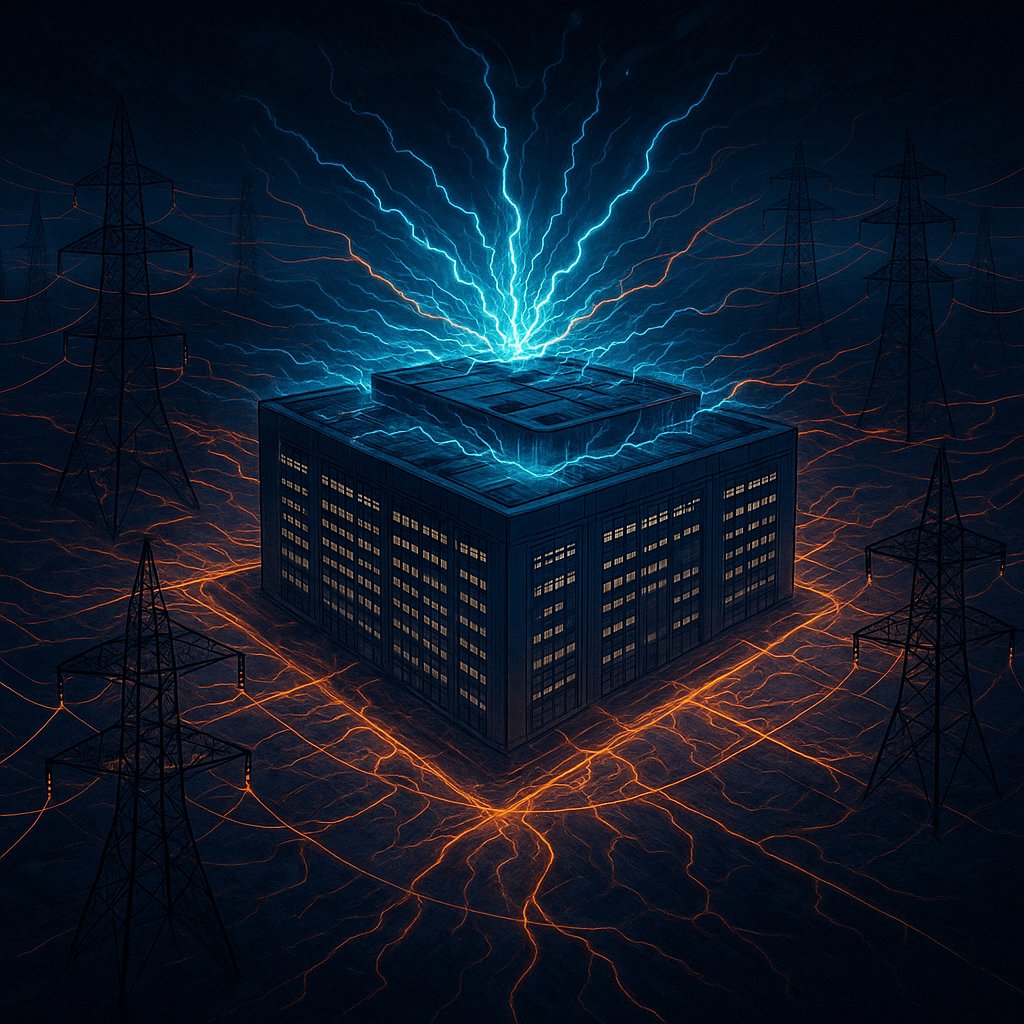
Researchers have demonstrated that ordinary cloud GPU access can manipulate a data center's power draw rapidly enough to destabilize the electrical grid it relies on. No exploit, no breach — just compute.
Most cyberattacks require some form of unauthorized access — a stolen credential, a software vulnerability, a misconfigured server. The Bit2Watt attack, detailed by three researchers from Zhejiang University in a paper accepted to CHES 2026 (the IACR’s annual conference on cryptographic hardware and embedded systems), operates on an entirely different premise. A legitimate cloud tenant, using nothing more than ordinary GPU access they have already paid for, could potentially destabilize the electrical grid supplying the data center they are running workloads on.
No zero-day. No privilege escalation. Just compute.
The core insight behind Bit2Watt is deceptively simple: modern GPUs can swing their power consumption dramatically within very short timeframes. A workload can be deliberately engineered to toggle between high and low GPU utilization in rapid, rhythmic cycles. When multiple tenants — or a single large tenant with many GPU instances — do this in a coordinated fashion, the aggregate power draw of the data center fluctuates sharply and periodically.
Power grids are engineered to handle gradual fluctuations in load, but sudden, high-frequency oscillations are a different matter. Grid operators and the transformers, frequency regulators, and automatic switching equipment that keep electricity flowing are sensitive to abrupt demand spikes and drops. The researchers measured real power responses in their experimental setup and, separately, modeled the potential effects at data-center scale. Their findings suggest the oscillations achievable through coordinated GPU manipulation fall within ranges that could trigger protective relays, stress transformers, or cause localized frequency instability on the grid segment feeding a large facility.
What makes Bit2Watt stand out from conventional infrastructure attacks is its combination of accessibility and plausible deniability. An attacker does not need to penetrate any internal network. Cloud computing is explicitly designed to let customers run intensive, fluctuating GPU workloads — that is the entire product. Distinguishing a malicious oscillating workload from an ordinary machine learning training job or a rendering pipeline is not straightforward, either for cloud providers or for the grid operators watching power meters downstream.
The attack also sidesteps the usual defenses. Firewalls, intrusion detection systems, and patch management are irrelevant here. The threat surface is physical: the cables, transformers, and switching infrastructure that nobody in a cloud security team typically owns or monitors.
The Zhejiang University team is careful to distinguish between what they measured directly and what they modeled. The physical power oscillation experiments were conducted at a smaller scale than a hyperscale cloud facility, and the researchers extrapolated to data-center and grid-level impact through simulation. That gap between lab results and real-world scale is significant, and independent replication at larger scales has not yet been published. The paper’s acceptance at a rigorous peer-reviewed venue lends credibility to the methodology, but the attack’s practical feasibility against a major cloud provider’s infrastructure — with its redundancies and power conditioning equipment — remains an open question.
There is also the question of cost. Sustaining the kind of GPU utilization needed to produce meaningful aggregate oscillations at scale would require either very deep pockets or a coordinated botnet of compromised cloud accounts, both of which raise the bar for a real-world adversary.
Bit2Watt arrives at a moment when the energy demands of AI infrastructure are themselves under intense scrutiny. Data centers are projected to consume electricity at a scale comparable to entire large nations within the next decade, and their growing footprint means their relationship with grid stability is increasingly consequential in both directions. This research highlights an underexplored attack surface: the physical layer where digital infrastructure meets the analog world of electrical engineering. Cloud providers, grid operators, and security researchers have typically operated in separate silos, but Bit2Watt makes a compelling case that those silos need to be broken down. Defending against this class of threat will require collaboration between disciplines — cloud architecture, power engineering, and policy — that rarely sit in the same room together.